
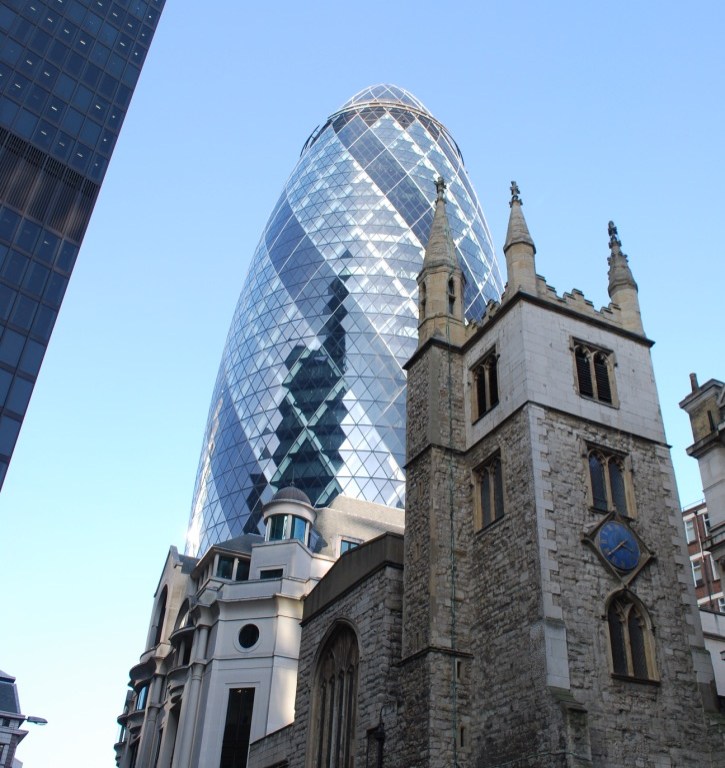
Built with a keen eye for elegance the Gherkin has become known as one of London’s most iconic modern structures. Designed by the architect Norman Foster this missile shaped building shows off it’s savvy structural design as an architectural feat.
Main Structural System: Diagrid (shortened from Diagonal Grid) frame. This structural system creates a notable diamond pattern in the exterior envelope of the building.
Novel in its modern time use this is one of the first few projects to bring diagrids back into the world’s spotlight for elegant and intelligent building design.
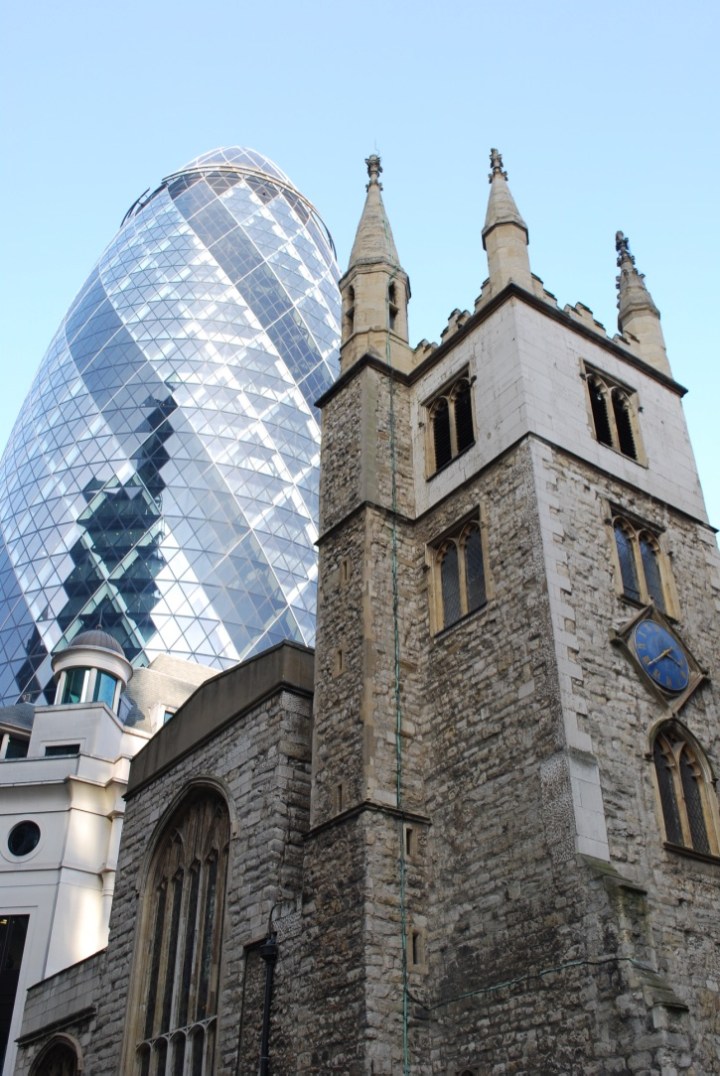
As opposed to traditional frame buildings comprising columns (purely vertical load bearing), beams (vertical and lateral load carrying) and diagonal bracing (axial load carrying), a diagrid envelope utilises diagonal members and beams connected at critically connecting intersection node points.
The diagrid transfers loads down the diamond shaped through the diagonal members to the base eliminating the need for perimeter columns. The members of a diagrid structure behave as a combined column-beam-bracing system.
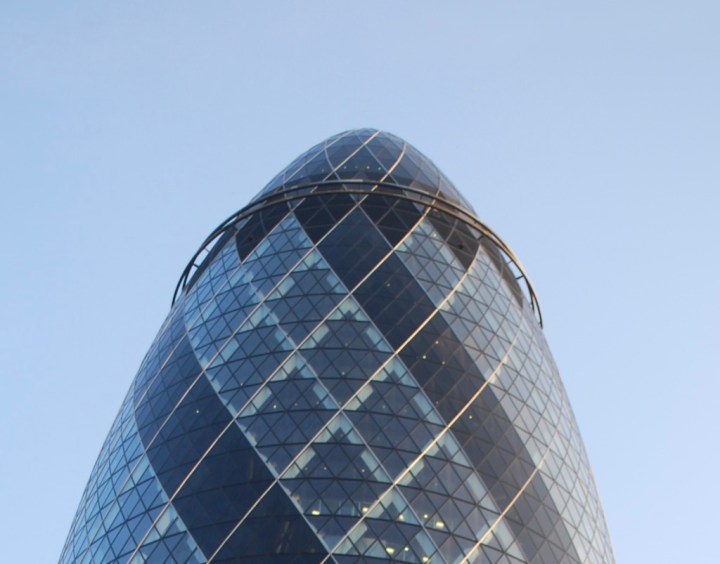
Despite it’s elongated egg shaped appearance the external cladding contains approximately 7500 diamond shaped panels of flat glass laid within the steel diagrid frame, with only the apex glass being curved.
The circular plan and aerodynamic shape of the Gherkin results in lower wind deflections than what would be experienced by a typical rectangular shaped building of comparable size.
External pressure differentials through a two layered curtain wall system is used to drive combined natural ventilation and mechanical ventilation throughout the building.
Heat builds up in the air gap between the external double glazed façade and rectangular interior single glazed curtain wall. This heat escapes from vents located at the top of every other floor.
Located at the tinted glass exterior are areas where the enclosed gap between internal and external wall open up into the spiral atria where the internal glass wall is removed.
These visually pleasing upward drawn façade spirals of course add to the glamour of the building.
The tinted exterior reduces solar heat gains and locally contains some windows that can be opened to allow circulation of “fresh” London city air
Other Engineering Features: Utilises natural ventilation.
Key Challenges & Constraints: Maintain London site lines.
Location: City of London, London, England, United Kingdom.
Nearest Underground Tube Station: Aldgate (5min walk), Liverpool Street (8min walk), Bank (8min walk)
Contractor: Skanska
Structural Engineer: Arup
Arhcitect: Norman Foster
Construction Date: 2001
Construction Completed: 2003 (Building open in-use 2014)
Height: ~180m
Size: 48,000 sq m
Other Examples of Diagram Structures:
- Aldar HQ, Abu Dhabi, UAE
- Guangzhou International Finance Center, Guangzhou, Guangdong, China
- Capital Gate Tower, Abu dhabi, UAE
- Myzeil Shopping Mall, Frankfurt, Germany
- Poly International Plaza, Beijing, China
- Hearst Tower, Manhattan, New York, USA
- CCTV HQ, Beijing, China
- Atlas BuildinG, Wageningen, Netherlands
Sources:
Diagrid Structures: Innovation & Detailing by T. M. Boake
Diagrid Weebly page by Nikita Chauhan, Rahul Kerur, and Chloe Wan
Hope you enjoyed this engineering overview of The Gherkin! We post these articles with you in mind and strive to provide content you desire! If you would like to see additional information on this engineering marvel or a profile of a specific engineering structure not yet posted – please get in touch by posting a comment or using our Contact Form. 🙂
Don’t forget to Like, Comment & Subscribe to The World of Engineering!
Thank you for reading and see you next time.
All content and photos belong to The World of Engineering (c). If you wish to use any of our content please contact us.
 The World of Engineering