
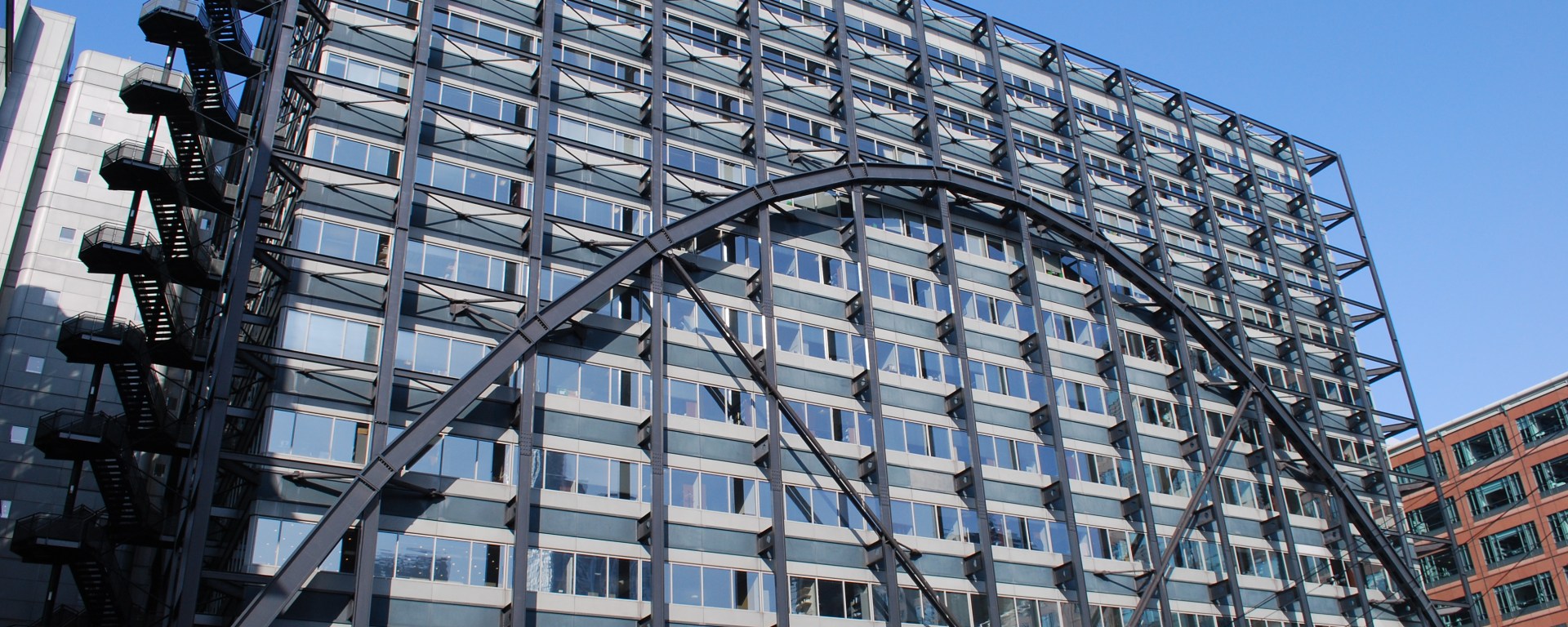
Built in 1990, Broadgate Exchange House adds a dramatic back drop to the business like appearance of Exchange Square with it’s black painted steel exoskeletal form and unexpected funicular arch.
Not only is it’s bridge-like form a necessity to deal with the site constraints, the style also pays homage to traditional Victorian train shed structures.
Main Structural System: Steel frame + Four tied parabolic arches located on the north and south facades bearing onto piers.


The structure combines the principles of building and bridge technology to span 78m above Liverpool Street Station’s busy railroad train tracks beneath.
A steel frame + four tied arches located on the north and south facades act together with a grid of posts and hangers to form the columns of the structure. These support and distribute it’s weight onto piers located at the four base corners.
A large raft slab forms the ‘ground’ floor underneath Exchange House and the roof of the underlying railway tracks.
The tapered concrete piers are situated on top of hand minded piled foundations either side of the railway tracks.


Key Challenges & Constraints:
- Located above congested railway tracks leading up to a busy London city centre rail station leading to the requirements to achieve a clear span of 78m.
Location: City of London, London, England, United Kingdom
Nearest Underground Station: Liverpool Street Station
Main Contractor: Bovis Construction Ltd
Structural Engineer: Skidmore, Owings & Merrill (SOM)
Architect: Skidmore, Owings & Merrill (SOM)
Client: British Land
Construction Start Date: 1990
Size: 10 storey office block with an approximate height of 60m and 390,000 sq ft floor area.


Hope you enjoyed this engineering overview of Exchange House! If you would like to see a profile of any specific engineering structure, please get in touch using our Contact Form and we will strive to provide the content you desire! 🙂
Don’t forget to Like, Comment & Subscribe to The World of Engineering!
Thanks for reading!
All content and photos belong to The World of Engineering (c). If you wish to use any of our content please contact us.
 The World of Engineering